도서 소개
The publication of Korea Craft & Design Foundation, “Korean Craft & Design Resource Book” series, aims at distributing the knowledge on the traditional craftsmanship and technology of Korea, and at providing them not only to experts of relevant fields, but also to the public.
출판사 리뷰
The completion of Ottchil crafts requires a complicated process, time, patience and devotion. For the book Ottchil: Korean Traditional Lacquer we asked multiple experts for advice to retrace the values and merits of the traditional lacquering technique and bringing them to a wider audience.
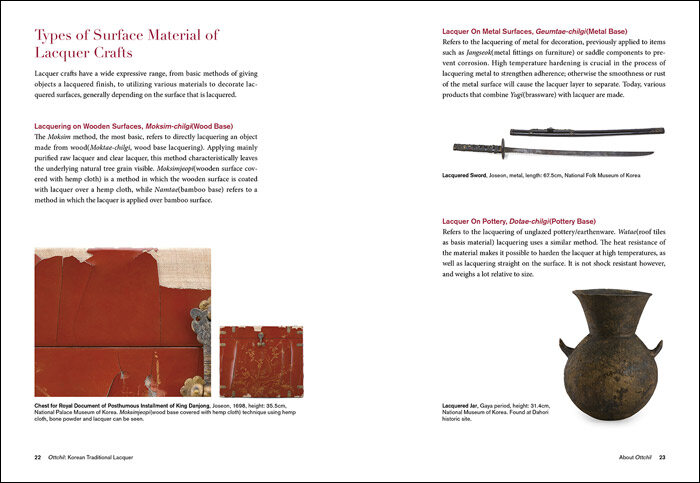
This book covers lacquering craft according to base materials: wood, metal, ceramic, fabric, paper, and leather, while explaining lacquer paintings separately.
We tried to provide a comprehensive introduction to lacquering from its origins, history, and current state, to necessary tools, historical artifacts and modern application. We also crafted some lacquerware works in order to provide even more detailed visuals and explanations for some techniques involved, in hopes of making the processes readily accessible to novices.
■ Despite the use of lacquer as the finest pigment since ancient times, few domestic publications detail its techniques, while the technical jargon makes existing publications inaccessible for the general public or apprentices to the craft. The emphasis on nontoxic environments and household items for healthy living amongst today’s rapidly aging population is enhancing the value of lacquer for its various beneficial properties. Additionally, Korea’s recovering economy is enabling the consumption of luxury items such as hand-crafted, high-end lacquer ware and art products among the general public.
Ottchil, Korean Traditional Lacquering, details various techniques used in lacquerware crafting processes with visuals and simple explanations, introducing the general public to the value of lacquer ware, while providing hands-on guidance for apprentices to the craft.



Lacquer trees maintain a certain amount of sap internally and excrete it to protect itself when its bark is breached, which is referred to as ‘lacquer sap’.
To collect lacquer sap, the bark of living trees is removed, exposing the sap secreting organ, which is breached to encourage the sap to ooze out. Raw lacquer sap contains various substances such as urushiol, nitrogen, gum, water, etc. The ash colored milky sap has a bittersweet taste and oxidizes into a brown color. Prolonged oxidization hardens the surface into a dark brown colored cover that prevents further oxidization, which is why lacquer sap is described as having ‘hardening’ and ‘drying’ characteristics.
-from. 'Chapter 1. About Ottchil'
Lacquer sap is hand-collected from early June to late October from standing trees. The trees should be at least six years old; the best age for harvest is between eight to ten years. While Jichil(arborization: cutting off branches and collecting lacquer from them) and Hwachil(collecting lacquer by heating lacquer tree) techniques were mainly used in the past, ‘collecting lacquer and cutting off’, ‘collecting and curing’, ‘collecting from upper and below parts at the same time’ methods are the main collecting techniques used today.
-from. 'Chapter 2. Tools and Material for Lacquering'
작가 소개
저자 : 조훈상
문화재재단 전통공예건축학교 옻칠전문과정 이수자, 디자인그룹넥서스 대표
저자 : 김미라
문화재청 감정 위원
저자 : 김정은
옻칠화 작가, www.morae-kje.com
저자 : 이희승
국가무형문화재 칠장 이수자, S&W Lacquerware 대표
목차
Chapter 1. About Ottchil
Defining Lacquer 14
Characteristics of Lacquer 16
Types of Lacquer 18
Types of Surface Material of Lacquer Crafts 22
History of Lacquer 28
Lacquer in China, Japan, Vietnam and Myanmar 36
Chapter 2. Tools and Material for Lacquering
Collecting Lacquer 44
Beginning Lacquer 48
Chapter 3. Applying Lacquer
Lacquering on Wood Base(Moksim) 56
Lacquering on Metal Base(Geumtae) 66
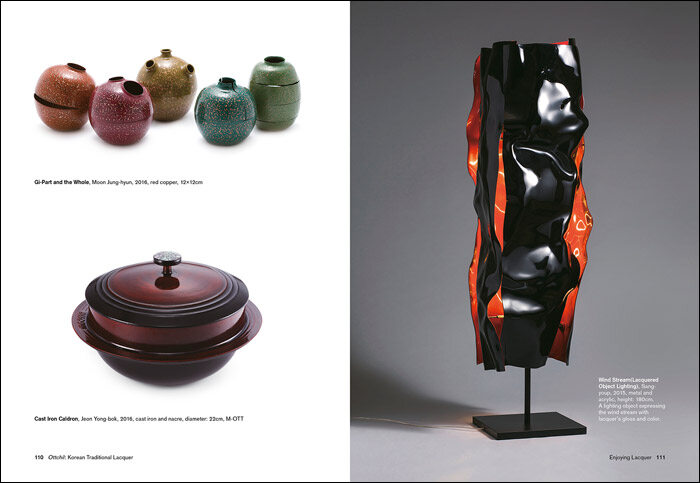
Lacquering on Pottery Base(Dotae) 70
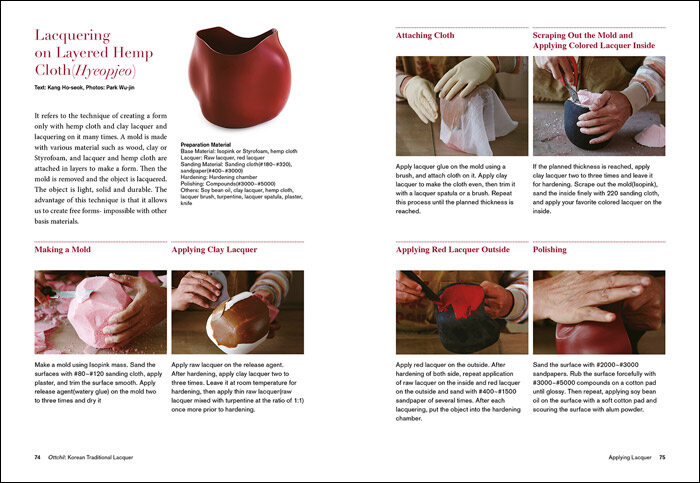
Lacquering on Layered Hemp Cloth(Hyeopjeo) 74
Painting with Colored Lacquer(Chaehwa) 76
Chaper 4. Enjoying Lacquer
Wood Base Lacquering: Solidity and Beauty in Daily Life 82
Metal Base Lacquering: Adding Gloss to Shine 104
Pottery Base Lacquering: Fusing Together with Earth 112
Layered Cloth Base Lacquering: Feeling Free to Form 116
Hanji Base Lacquering: Giving a New Birth to Korean Paper 124
Leather Base Lacquering: Balancing between Toughness and Solidity 130
Lacquer Painting: Making Things Bloom 134
Appendix
List of Masters 144
Craft & Design Map 145
List of Plates 146
Bibliography 149
Collaborators 150
Index 151